Thankfully, my dogs do not have to deal with snow salt affecting their paws in the wintertime. We live on a corner lot that faces a two-lane, main-street-type road, with the side of our home facing a dirt road. While the main road does require snow management services such as plowing and salting, the dirt road does not.
Furthermore, we do not walk our furry companions along the side of the road, but when the sidewalks finally get installed by next fall, we will have the ability to take them for walks, and I’m sure they will get salted by the township, so I will have to take preventative measures to avoid complications to their paws from the salt.
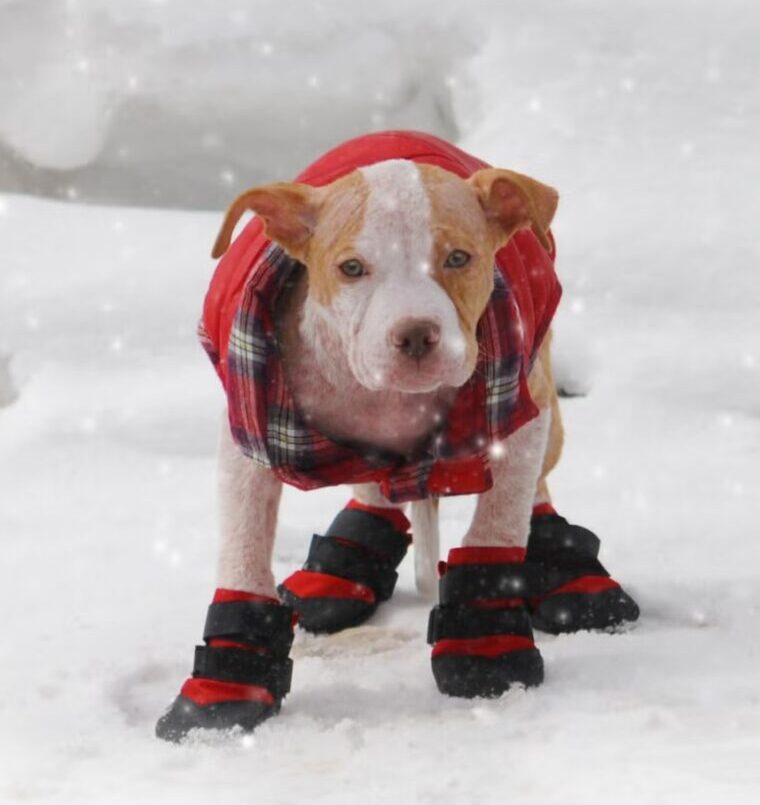
My mother-in-law lived in condominium complexes for the last fifteen years of her life, and she always had a dog to walk. When winter arrived, and their snow contractors came to treat the roadways and sidewalks, she would put little booties on her dogs’ paws to protect them from the salt while on their daily walks.
Although it protected their paws, the dogs hated having them on, and they walked funny in the beginning. It was probably one of the funniest things I have ever seen (ha, ha). If you have never seen this phenomenon, Google dogs with boots videos and prepare to laugh – poor pooches!
According to ASPCA® (American Society for the Prevention of Cruelty to Animals®), “Ice melts are commonly made of different kinds of salt. Sodium chloride, potassium chloride, calcium chloride and magnesium chloride are all common ingredients.
While pets don’t typically ingest ice melts on purpose, your pet may become exposed if they lick their feet after walking through a recently treated area, or by eating snow that may have ice melts in it.
Due to the risk of slipping and falling not only for us but for our furry friends, ice melts are a necessity in many parts of the country. There are, however, a few things you can do to minimize potential problems for your pets:
- Don’t let dogs eat any of the salt or any of the snow (especially the slushy snow) outside that may have been treated with an ice melt.
- Wipe your pet’s paws as soon as they get inside with a damp cloth or baby wipes. Minimize paw licking until their paws are completely clean. This will also help minimize risk for skin irritation that may be seen from walking through ice melts
- If you have a sensitive dog whose paw pads are becoming irritated, cracked or are bleeding from the ice melts, paw wax or doggie booties provide an excellent barrier to minimize risk to sensitive feet.
- Keep all ice melt packaging out of paws’ reach.
If your pet has been exposed to an ice melt or is showing symptoms indicative of ingestion, it is important for you to contact a veterinarian or APCC at (888) 426-4435 immediately,”.
(Photo Credit: Country Living)
Dogs that love the snow
As far as the furry family members that have been in my Pack, Luke definitely stands out as one who adored playing in the snow even though his breed does not make the list of breeds that love the snow.
My ex-husband has been a landscape contractor for more than thirty-five years and plows snow in the winter. When we had our Little Lukey, a Cocker/Poodle/Shiatzu mix, my ex would shovel a maze-like path with several offshoots for him in the snow so he could go potty in the yard instead of under the deck, as that’s a particularly difficult spot to get to, come springtime.
The American Kennel Club (AKC) states that, “With winter comes the cold. But some dogs don’t hate the cold; in fact, several breeds absolutely love it! (Note: Just because these dogs were bred to withstand cold temperatures does not mean it is safe to leave them outdoors for long on cold days. They, too, can get frostbite and hypothermia.)
Here are seven cold-weather dog breeds that may enjoy some time in the chilly weather.
- Alaskan Malamute
- Keeshond
- Newfoundland
- Norwegian Elkhound
- Tibetan Mastiff
- Siberian Husky
- Saint Bernard,”.
On the other hand (or paw), our larger dogs would merely walk through the snow to make their own paths, but jeez-o-pizza, it is so gross-looking with all that poop sitting on top of the white snow (ewww).
Does weather affect dogs
Yes, I believe so, especially when it is raining. All eight of my dogs are well-behaved, loving furry family members. However, a select few of them have been especially stubborn when it comes to rainy days and going outside to go potty. They seem to have a mind of their own on these wet and dreary days – but I cannot blame them; I’d feel the same way!
Here is a list of my dogs, their breeds, and their rainy day preferences:
- Josi, Chocolate Labrador – big baby in the rain and thinks she’s going to melt, but loved swimming and playing in puddles more than life itself
- Roxy, Shepherd/Collie/Coyote mix – loved the snow, did not like the rain but loved swimming as much as her sister Josi
- Luke, Cocker/Poodle/Shiatzu mix – loved the snow even though he was a short dog; he hopped through the deep snow like a bunny rabbit, and he didn’t care about the rain either
- Clio, Australian Shepherd/Beagle mix – Did not like the snow or rain
- Phoebe, Labrador/Pitbull mix – did not like getting wet in the rain or swimming in the lake but enjoyed playing in the snow with her boys (my sons)
- Otis, German Shepherd – loved all types of weather and was probably the easiest-going dog I had. I miss my Oti-oti-o 🙁
- Lucy, German Shepherd/Labrador/Pitbull mix – does not enjoy swimming, just like her mom (Phoebe), nor does she like being out in the rain, but loves to play in the snow like her dad (Otis)
- Mila, Staffy/Bulldog mix (One year old) – so far, she likes all types of weather but gets cold easily since her hair is so short and thin
Snow salt and dogs
In conclusion, snow salt, and dogs don’t always mix, but a little planning helps. Protect their paws, clean up after walks, and enjoy winter together while respecting each dog’s health and preferences.